There's a tiresome term that gets tossed around in the endless attempts to find ways to describe improvised music that doesn't sound jazzy. Technically, "classical" refers to a period in the history of European composed music, the late 18th and early 19th centuries. So, Beethoven is a classical composer, Bach and Schoenberg are not. Colloquially, the term has come to refer to most anything that sounds something like symphonic or chamber music — thus we might refer to John Zorn's "classical" work, a puzzling, if perhaps acceptable, sort of inverted anachronism. And then by extension we occasionally get the even more troubling notion of "classical improvisation" (There was, perhaps, such a thing. Beethoven and other composers were famed in their time for the piano improvisations that followed performances of his composed works, things that sadly we'll never hear.)
The problem runs deeper as we allow value judgments in. "Classical" is seen, opera aside, as the highest form of composed music, and as such can be a path (by prestige if not by payment) out of the jazz ghetto. This music was written down! It uses strings and flutes! It is high art! All of this could be sidestepped by using more value-neutral terms, such as "chamber improv" but, well, what's done is done.
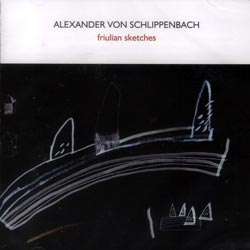
Pianist Alexander von Schlippenbach addresses another level of the problem in the notes to his Friulian Sketches, and in the music arguably undermines the false divisions. He writes that within the German copyright system, music is divided into two categories: "serious" and "popular / not serious," and writes that "if we as improvisers remain stuck in the lowest category without complaining, we'll also have the moral bonus of serving 'Serious' Music and its noble demands, while there is a continuous digging away through doing our little bit towards the advancement from [not serious] to [serious]."
von Schlippenbach is an avuncular figure (there being something more like brothers than a single father) in the development of German free improvisation, stretching back to 1966 with the formation of his Globe Unity Orchestra. He is avowedly a jazz (not serious?) musician, often referencing Thelonious Monk and Herbie Nichols in his playing and discussion. But there is an undeniable, if born of false dichotomy, formalist feel to Friulian Sketches. The set of 20 brief improvisations (only one breaking five minutes) takes the classic piano trio and massages it toward chamber music, replacing the saxophone with clarinet (Daniel D'Agaro) and the string bass with cello (Tristan Honsinger). It's just a violin away from Messiaen's Quatuor pour la fin du Temps, a composed work not of the classical period but still earning more seriousness stripes than, say, Monk.
And it's not just the instrumentation that bears resemblance to Olivier Messiaen's great work. The playing here is somber, sometimes mournful, a gravity at times broken by the fantastic range of D'Agaro's playing, jumping from reedy moans to sprightly yelps. Honsinger's deep bowing and melodic pizzicato resonate throughout, and von Schlippenbach is beautifully graceful, pointedly underlining the fact that spontaneity need not preclude formality. It's a surprising work from a player who often is steeped in the "classical" period of free jazz — from Monk to Trane — and on its own terms is quite beautiful.
Comments and Feedback:
|